
What’s a personal mantra or philosophy you live by?
View all responses
Once again, I’ve been lured by the WordPress daily prompt.
I can’t say I was ever consciously looking for a particular mantra or philosophy to follow. But somehow, over time, something I had tattooed on my skin 15 years ago has perhaps become one.
I’ve already talked about my tattoos here and even included a photo of the particular one I’m talking about.
It’s the one that has random strangers pulling off a variety of neck contortions as they try to read the text that wraps around my arm.
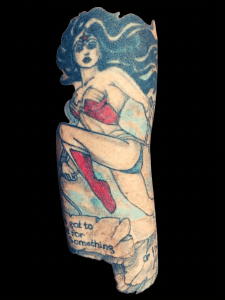
Okay, time for some brutal honesty. I didn’t unearth this from an ancient leather-bound philosophy tome. I got the quote from a film released in 2011. One that I enjoyed at the time but, 15 years later, had to use a search engine to remember the name of today! So, you know, not exactly a cinematic masterpiece. *It’s called Sucker Punch if you’re interested*
Variations of this quote have been attributed to loftier characters. It’s often credited to historical figures like Alexander Hamilton or Malcolm X. Alas, dear readers, I heard it uttered by a character called The Wiseman and I erm… well I thought it sounded cool. *Cue the internal cringe*
In fact, I liked it so much, I decided to incorporate it into my Wonder Woman tattoo design. At the time, I didn’t particularly “stand for” anything. But, I have often fallen for things.
And honestly? Most of us have. It’s part of the human condition. We want to believe the stories we’re told, especially when they appeal to our sense of justice, fear, or outrage. We want to stand for the good guys.
But what happens when the “something” we are being urged to stand for is a total fabrication? What happens when our basic human desire to do the right thing is weaponised against us?
This is where the second half of my tattoo’s warning comes into play – because when we don’t know what’s real, we all risk falling for everything.
In the world of geopolitics and history, this is the architecture of the false flag…
The term itself actually comes from the high seas, back when pirates or naval fleets would fly a literal false flag of a friendly nation to trick their enemies into letting their guard down. But while the maritime tactic is ancient history, the psychological trick remains exactly the same today.
When governments, agencies, or powerful entities want to push an agenda that the public would normally reject – like going to war or surrendering privacy rights – they don’t ask us nicely over a cup of tea. They create a crisis that forces our hand, counting on the fact that we’ll be too panicked to notice the flag they’re flying is a fake.
But, once you learn to spot the theatrical staging, you stop reacting to the outrage and start asking the most important question in history: Cui bono? Who benefits?
History is littered with the debris of these engineered illusions. If you think this sounds like the plot of a generic spy novel, you only need to look at the declassified realities of the 20th century.
Operation Northwoods (1962)
- The Setup: In 1962, the US Joint Chiefs of Staff signed off on a plan to commit real and simulated acts of terrorism on US soil. This included blowing up American ships, hijacking commercial planes, and orchestrating bombings in Washington DC and Miami – all while framing Fidel Castro’s Cuban government. Thankfully, President John F. Kennedy looked at it, presumably said “are you mad?” and rejected it.
- Cui Bono? The US Military Establishment and Intelligence Agencies. The benefit was a manufactured casus belli (an act justifying war). It would grant the military full public and international backing to invade Cuba and overthrow Castro.
The Gulf of Tonkin Incident (1964)
- The Setup: On August 4, 1964, the US Navy claimed that North Vietnamese torpedo boats launched an “unprovoked attack” against American destroyers in international waters. Decades later, declassified documents and NSA histories revealed the truth: the attack never actually happened. It was a chaotic mix of bad weather, radar anomalies and deliberately skewed intelligence.
- Cui Bono? The Johnson Administration and the Military-Industrial Complex. President Lyndon B. Johnson used this ghost attack to immediately pass the Gulf of Tonkin Resolution through Congress. It gave him a political blank cheque to rapidly escalate military intervention. This single fake event dragged the US completely into the Vietnam War.
When you point out these historical facts, it doesn’t take long for someone to bring out the “conspiracy theorist” label. The phrase itself has been thoroughly weaponised to make anyone asking Cui bono? look like they’ve lined their living room with tin foil and are out hunting Bigfoot in their spare time.
But here’s the truth: just because a concept is beloved by late-night internet sleuths doesn’t mean the underlying strategy isn’t real. False flags didn’t magically stop happening when the calendars flipped to the 21st century. The playbooks haven’t changed; the stage has just moved to digital spheres and 24-hour news cycles.
Take the recent flydubai Flight 1073 incident on September 30, 2026. As soon as the news broke that a co-pilot had attacked the captain with a crash axe in an attempted suicide attack bound for Tel Aviv, the internet fractured into instant narratives. Before the plane’s tyres had even cooled on the tarmac in Saudi Arabia, factions were already claiming it was an engineered event designed to provoke regional conflict or justify stricter digital surveillance.
Are those theories true? The official investigations point to a lone-wolf extremist who slipped through security cracks. But the fact that the public’s immediate reflex is to question the theatre tells us something profound. We have been lied to so many times by historical institutions that our collective guard is firmly up.
And that brings me back to the ink wrapped around my arm.
Being sceptical doesn’t mean you have to believe every wild thread on a forum written by a user named XFilesTruthSeeker420. It just means refusing to let your natural empathy, fear, or anger be hijacked by the first breaking news alert on your screen. We don’t have to wear the tin foil hat to realise that the information coming at us is often heavily curated to provoke a reaction.
So, how do we stand for objective truth without losing our minds or turning into raging cynics? We switch from panic mode to detective mode.
Here are a few practical, everyday tools for the modern truth-seeker:
- The 24-Hour Cooling-Off Period: When a major news story breaks and hits you right in the emotional solar plexus, stop. Don’t share it. Don’t tweet your outrage. Give it 24 hours for the initial fog of war – and the instant narratives – to clear. ⏱️
- Diversify Your Information Diet: If you only get your news from one source (or worse, a single social media algorithm), you’re only seeing one side of the story. Read widely, look at international coverage and check what independent journalists are saying. 📚
- Get into the Cui Bono? Habit: Make it a game. Whenever a new policy, war, or surveillance law is being aggressively pushed off the back of a crisis, ask yourself: Who gains money, power, or control from this? The answer is usually far more telling than the headline. 🔍
We don’t have to be passive consumers of manufactured crises. By choosing a healthy dose of doubt, demanding rigorous evidence and protecting our empathy from being weaponised, we can keep our feet firmly on the ground.
Looking down at the ink wrapped around my arm today, I finally realise what it actually means to me. Standing for “something” doesn’t mean picking a side in a rigged game, choosing a faction, or buying into a political tribe. It means choosing to stand for humanity. It means standing for all of us. Because at the end of the day, looking out for each other is still worth standing for.
Citizen Jane x ✌️
Over to you, truth-seekers!
Now I want to hear from you. Do you have a personal mantra, a life philosophy, or a slightly embarrassing movie quote keeping you grounded? (Seriously, if I can admit to Sucker Punch, you can share yours! 😉)
Drop a comment below 👇 – and bonus points if your philosophy is already immortalised in ink!


Now it’s your turn! Join me here and let’s keep talking…👇🗣📣