I’ve never been interested in kings or queens. I’ve always been more drawn to outlaws and rebels – both fictional and real!
If you’ve got a spare six minutes, I would like to tell you a little about my favourite Scottish Knight. His name is Sir William Wallace.
You might know the name from the epic movie, Braveheart. It was released in 1995 with the tagline “Every man dies, not every man really lives”.
It has been described as one of the most historically inaccurate films of all time. It still won the Academy Award for Best Picture!
You might have your own feelings about the film. If nothing more, it introduced the world to an important part of my history. The Wars of Scottish Independence.
The film stars Mel Gibson in the title role. He also directed it and prioritized a cinematic experience that was entertaining and inspiring over historical facts. The film is almost three hours long.
The screenplay was based on a 15th-century poem called The Wallace. A long, epic narrative poem divided into 11 books. Although the poem and film take ‘creative liberties’ with history, it’s still a powerful story.
The real William Wallace was a Guardian of the Kingdom of Scotland. A title he earned alongside Andrew de Moray after the victory at the Battle of Stirling Bridge. The battle is depicted in Braveheart but drastically altered. They left out the bridge and Andrew for a start!
It’s an epic scene nonetheless. Maybe even the most memorable part of the movie. I’ve linked to a clip here. Even if you don’t know the film, I think you’ll recognise this part!
As the scene begins, Wallace arrives on horseback to the battle front. The Scottish soldiers are greatly outnumbered. Facing certain death against the English forces, some of the men don’t want to fight. Wallace addresses their fear in this speech;
“Aye. Fight, and you may die. Run, and you’ll live, at least a while. Dying in your beds many years from now, would you be willing to trade all the days from this day to that for one chance, just one chance, to come back here and tell our enemies that they may take our lives, but they’ll never take our freedom?“
His words rouse the soldiers, their fear transformed into a unified fighting spirit and resolve. They achieve a decisive victory over the English army, with a large number of English soldiers killed.
There is no historical evidence that the real Wallace gave that speech. Even so, I think it’s the bit that everyone remembers. Maybe not the whole scene but the battle cry of “freedom!”. And probably his blue face.
I’m not going to go through the movie scene by scene! I’ve done clickable links throughout this post with more detailed information.
In fact, let’s skip towards the end of the fictional Wallace’s life. It’s a thirty-year old film but I’ll give you a *spoiler alert* warning just in case!
The last scene shows his execution at Smithfield. Wallace refuses to submit, even while being disemboweled. The magistrate tells Wallace to ask for mercy and be granted a quick death. Instead, he shouts, “Freedom!”. His cry is the last thing heard by the king, who we see on his deathbed. Just before being beheaded, Wallace sees a vision of his wife, Murron, in the crowd.
The movie cuts to the future. Robert the Bruce, now King of the Scots, leads his men at the Battle of Bannockburn. He declares, “You have bled with Wallace—now bleed with me!” The Scots charge the English army…the enduring spirit of Wallace’s rebellion and Scotland’s path to freedom begins.
How’s that for an ending? I can see why it won those Oscars!
On 23rd August 1305, the real Sir William Wallace was found guilty of treason and sentenced to death.
His death and the trial was made into a public spectacle. There was no jury or opportunity for Wallace to defend himself. He refused to accept the English king’s authority. He is said to have declared, “I could not be a traitor to Edward, for I was never his subject”.
Wallace was declared a traitor to the English king. He was sentenced to be hanged, drawn and quartered on the same day as his trial. After his death, Wallace’s head was dipped in tar and placed on a pike on London Bridge. To warn others away from rebellion.
Once removed, each one of his limbs were also displayed; in Newcastle, Berwick, Stirling and Perth. His exact last words are not known, as no historical record exists of them. There is no record of a wife.
What’s that old saying about History being written by the victors…?
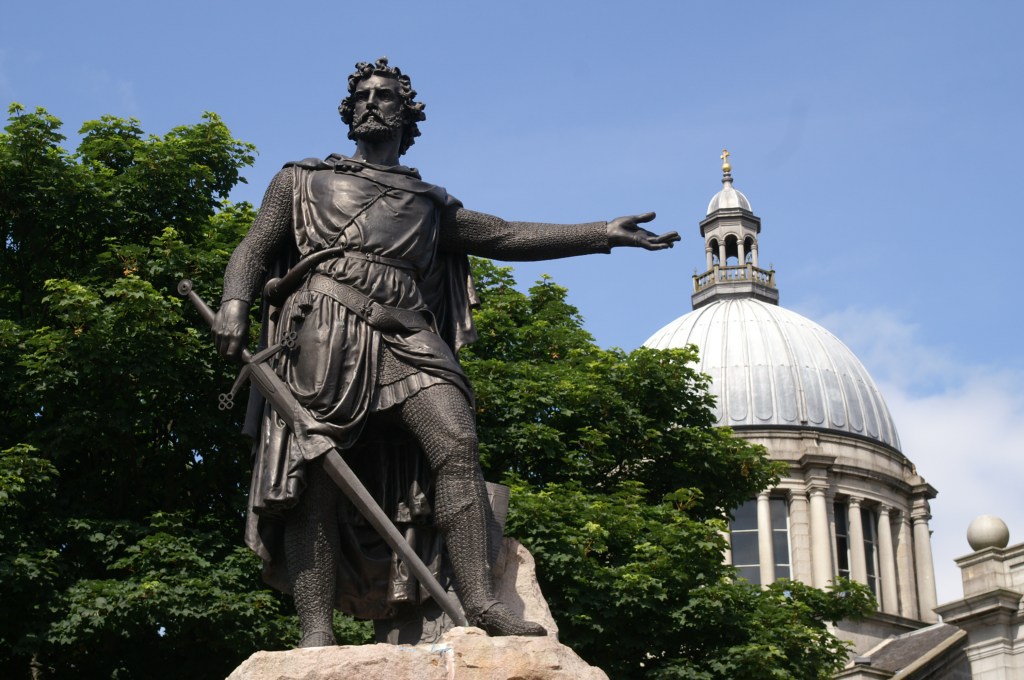
There’s a statue of William Wallace in Aberdeen. It’s the photo I used for this blog post. It has an inscription on each of its four sides. On the west facing side are the words;
“When I was a youth, and under the care of my Uncle, all that I could carry away from him was a single proverb, but it seemed to me above all price, and I never forgot it. It was this: – ‘I tell you a truth, liberty is the best of all things, my son, never live under and slavish bond.”
The speech in Braveheart is probably more famous. But, that’s the quote I always think of when I hear the name.
I can’t help but admire a man whose ideals were more dangerous than all the king’s men put together. While Wallace lived, he was a powerful symbol of Scottish independence and defiance. Both a hero and a villain…depending on what side you were fighting for.
His bloody and brutal execution was meant to break the Scottish spirit. Instead it created a martyr. He left behind a legacy that remains vital to our Scottish national identity. Even now, 720 years after his death.
Wallace is remembered for standing up for what he believed in.
I admire him for having the courage to defend to the death those beliefs.
I’d like to have a hero like that in the world today. Wouldn’t you?
Citizen Jane x
p.s. I hope you’ve enjoyed reading about one of my heroes. Do you have any heroes? I’d love to hear about them in the comments below 👇


Now it’s your turn! Join me here and let’s keep talking…👇🗣📣